Table of Contents
- What Is Perfusion?
- What Is ATF (Alternating Tangential Flow) and How Does it Work?
- What Is TFF (Tangential Flow Filtration) and How Does it Work?
- ATF vs TFF: Side-by-Side Comparison
- Decision Framework: How to Choose Between ATF and TFF Perfusion
- Performance Considerations
- Cost and Timeline Considerations
- Real World Scenarios
- Final Thoughts
- References
Perfusion bioprocessing has become a core strategy for modern biologics, enabling higher productivity, longer run times, tighter control of product quality, and reduction of manufacturing costs. Two technologies dominate cell-retention in perfusion systems: Alternating Tangential Flow (ATF) and Tangential Flow Filtration (TFF).
While both approaches serve the same fundamental purpose, retaining cells while exchanging media, they differ meaningfully in shear exposure, scalability, operational complexity, and regulatory implications. Choosing between ATF and TFF is therefore not just a technical decision, but a strategic one that impacts manufacturability, compliance, and cost.
What Is Perfusion?
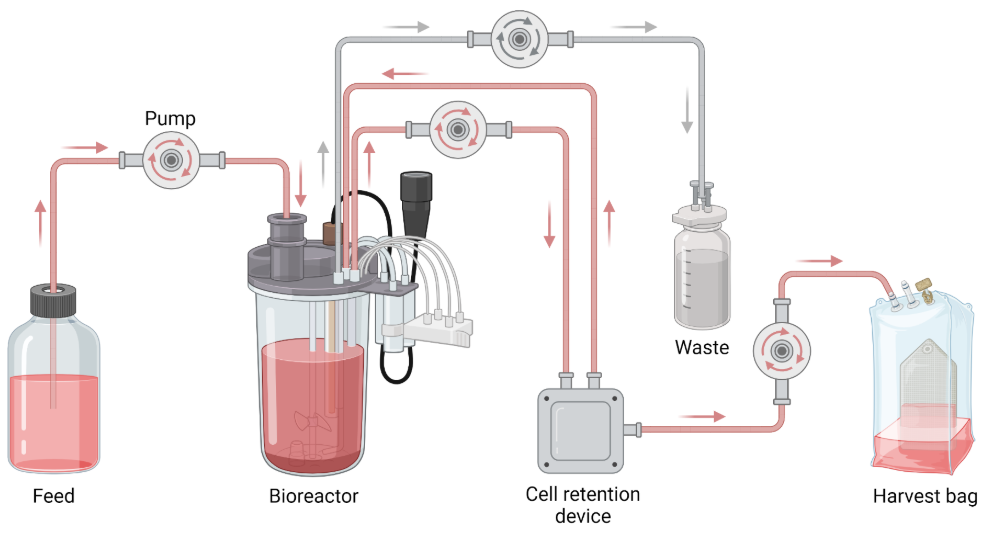
Perfusion is a continuous cell culture method in which fresh culture medium is constantly supplied to a bioreactor while waste products and depleted medium are removed, without losing the cells themselves. This allows cells to remain in a healthy, growing state for extended periods enabling high-density cultures and consistent productivity. Perfusion is used in biopharmaceutical manufacturing for producing monoclonal antibodies, therapeutic proteins and other biologics.
Key benefits of perfusion include:
- Higher volumetric productivity
- Bioreactor size reduction
- More consistent product quality attributes (CQAs)
- Reduced batch-to-batch variability
- Reduction of reagent cost per gram of product
Perfusion bioprocesses commonly rely on cell retention devices to sustain high cell densities while allowing uninterrupted product collection. Alternating tangential flow (ATF) and tangential flow filtration (TFF) systems have emerged as the leading cell retention technologies in mammalian cell perfusion applications.
Positioned in the recirculation loop between the bioreactor and media exchange, ATF and TFF systems largely dictate how effectively, consistently, and gently cells are retained throughout the perfusion process. Choice of cell retention device depends on desired cell density and viability, product retention targets, cost and operational flexibility and product sensitivity. Both technologies utilize hollow fiber membranes, allow reuse of the retentate stream, and offer scalable solutions for modern biopharmaceutical production.
What Is ATF (Alternating Tangential Flow) and How Does it Work?
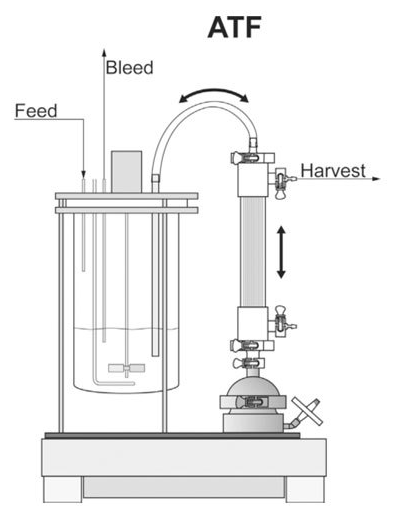
ATF systems use a diaphragm pump to generate alternating forward and reverse flow across a hollow-fiber membrane. This oscillatory flow minimizes fouling while keeping cells suspended and retained within the bioreactor. Unlike continuous unidirectional flow, ATF’s alternating motion reduces shear exposure, reduces membrane fouling and maintains higher product sieving.
Typical ATF Setup
A typical ATF setup consists of a bioreactor connected to a hollow-fiber filtration module, with a diaphragm pump used to generate the alternating forward and reverse flow that drives perfusion. Integrated pressure and flow sensors monitor system performance in real time, enabling tight control of shear conditions, membrane behavior, and overall process stability throughout long-duration perfusion runs.
Pros of ATF Perfusion
- Supports very high viable cell density (VCD)
- Low shear, ideal for sensitive cultures
- High product recovery
- Enables long, uninterrupted perfusion runs
- Strong process stability and reproducibility
- Lower rate of membrane fouling during high flux processes
Cons of ATF Perfusion
- Higher upfront equipment cost
- More specialized set-up and training
- Less process flexibility
What is ATF Perfusion Best For?
ATF perfusion is particularly well suited for high-density CHO cultures and other shear-sensitive cell lines where maintaining viability at elevated cell concentrations for long periods of time and high product recovery is critical. It is commonly selected for quality-critical biologics and advanced therapies, where long, stable perfusion runs and tight control of product quality attributes are essential. ATF typically outperforms conventional peristaltic pump-driven TFF systems in maintaining higher cell densities beyond 100 million cells/mL and more stable product sieving coefficients over long perfusion campaigns allowing for higher product recovery.
What Is TFF (Tangential Flow Filtration) and How Does it Work?
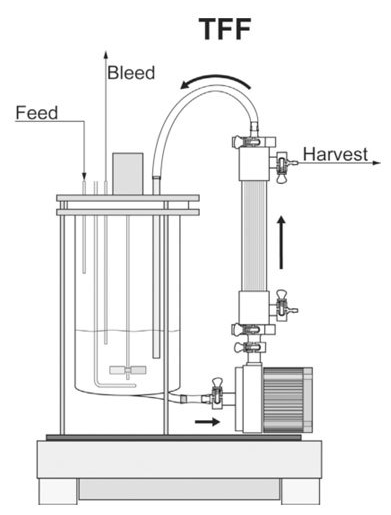
TFF systems use continuous crossflow across a membrane surface. Permeate passes through the membrane while cells and larger components remain in the retentate and are returned to the bioreactor.
Typical TFF Setup
A typical TFF setup consists of a feed pump that drives continuous crossflow across the membrane surface, with the retentate stream returned to the bioreactor and the permeate removed through a controlled outlet. Transmembrane pressure (TMP) is continuously monitored and actively controlled, as it is a critical process parameter under GMP that directly impacts flux, cell retention, and membrane integrity. Consistent TMP control during perfusion using a TFF set-up is essential for maintaining process stability, minimizing fouling, and supporting reproducible performance during perfusion operations.
Pros of TFF Perfusion
- Simple hardware architecture with more process flexibility
- Broad vendor ecosystem
- Familiar operation for many facilities
- Lower capital cost
- Easier to integrate into continuous bioprocessing downstream purification operations
- Preferred when needing to retain larger molecules within the bioreactor such as in viral vector and exosome production
Cons of TFF Perfusion
- Higher shear risk, increased membrane fouling and product retention at elevated flux
- More operator intervention
- Scale limitations in high-VCD processes
What is TFF Perfusion Best For?
TFF perfusion is best suited for processes that prioritize operational flexibility, downstream integration, and controlled product retention, particularly when implemented with modern low-shear pump technologies. When paired with low-shear pumping technologies, TFF can achieve cell culture and product recovery performance comparable to ATF while offering greater process integration flexibility. It can also be the optimal choice in facilities already standardized on TFF skids, where existing infrastructure, operator familiarity, and validated workflows enable faster implementation and smoother tech transfer.
ATF vs TFF: Side-by-Side Comparison
| Metric | ATF | TFF | Impact |
|---|---|---|---|
| Achievable VCD | Very high (> 100M+ cells/mL) | Moderate–high | Impacts volumetric productivity |
| Viability at High Density | Excellent | Variable due to potentially higher shear | Run length & consistency |
| Shear Exposure | Lower; gentle oscillatory flow | Potentially higher depending on pump and flow rates | Critical for sensitive lines such as CHO cells |
| Fouling Tendency | Reduced due to alternating flow | Higher in high flux processes | Requires periodic monitoring, downtime & cleaning |
| Process Flexibility | Limited to ATF-compatible configurations | Larger variety of membranes and setups possible; preferred choice in continuous bioprocessing | Timeline |
| Cost Considerations | Higher upfront capital cost | Lower; may already have equipment in-house | Timeline and cost of manufacturing |
| Product Retention | Lower; better for monoclonal antibody and other recombinant protein production | Higher; better for viral vector or exosome production | Process specific impact |
| Footprint & Hardware | Compact ATF module | Larger TFF skid | Facility fit |
| Scalability | Strong | Moderate | Tech transfer risk |
| Cleaning & Turnaround | Faster | Slower | Utilization |
Decision Framework: How to Choose Between ATF and TFF Perfusion
Selecting the right cell-retention strategy for perfusion is rarely a binary technical choice. Instead, it requires balancing biological goals, operational constraints, regulatory expectations, and timeline pressures. The framework below walks through a structured decision process, highlighting where ATF and TFF each introduce advantages and tradeoffs.
Step 1: Define Performance Targets
The first step is to clearly define what success looks like for the process.
Target viable cell density (VCD) is often the most decisive factor. Processes aiming for very high VCDs—particularly above ~80–100 million cells/mL—tend to favor ATF systems due to their lower shear profile and improved cell viability at extreme densities. TFF systems can support perfusion, but at high VCDs they may require more process development to determine optimal membrane type and TMC to decrease shear stress and fouling risk. At VCDs higher than 140 million cells/mL, medium viscosity increases significantly introducing operational challenges with either system [3]. In this case, ATF is limited by vacuum capacity and TFF by membrane and pCO2 constraints.
Titer and volumetric productivity are closely tied to VCD and run length. ATF systems often enable longer, more stable steady-state operation, which can translate into higher cumulative titers over time. TFF systems may achieve comparable short-term productivity but can become less predictable over extended runs due to membrane fouling and increased operator intervention especially if membrane type, flow rate and transmembrane pressure are not optimized.
Run length also plays a key role. If long, uninterrupted perfusion campaigns are a requirement, ATF typically offers greater robustness. For shorter or mid-duration runs, TFF can be sufficient and more cost-effective. TFF processes require more upfront process development and operational intervention during MFG to balance TMC and prevent membrane fouling during long perfusion campaigns.
Process type should also be considered. ATF has less product retention making it ideal for monoclonal antibody and other excreted recombinant protein products. TFF has higher product retention making it optimal for processes that require retention of larger molecules such as viral vector and exosome production. TFF can also be better suited to integration with continuous downstream processing since TFF gives direct control of the harvest flow producing a continuous liquid stream that can be fed directly into downstream operations.
Finally, critical quality attributes (CQAs), such as glycosylation consistency or aggregate levels, should be considered early. Lower shear environments associated with ATF are often better aligned with tight CQA control, while TFF processes may require additional monitoring and controls to maintain consistency.
Step 2: Operational Map and Facility Constraints
Once targets are defined, practical constraints often shape the final decision.
Cell line shear sensitivity is a primary consideration. Shear-sensitive lines tend to benefit from ATF’s oscillatory flow, which reduces mechanical stress. More robust lines may tolerate TFF’s higher shear, especially in highly developed processes.
Cleanroom space and facility layout also matter. ATF modules are typically compact and integrate closely with bioreactors, whereas TFF systems often require larger skids and additional floor space. Facilities with limited space may therefore lean toward ATF, while those already designed around TFF skids may prefer to leverage existing infrastructure.
Operator experience and training can influence implementation risk. Teams familiar with TFF systems may achieve faster startup and fewer early deviations using TFF, even if ATF offers theoretical performance advantages. Conversely, organizations with prior ATF experience may prioritize its long-term stability benefits.
Supply chain availability is another nontrivial factor. Lead times for ATF-specific components or membranes may differ from those for TFF consumables, which are widely available from multiple vendors. In time-sensitive programs, equipment availability alone can drive the decision.
Step 3: Score and Weight Tradeoffs
At this stage, many teams formalize the decision using a weighted scoring model.
If productivity is weighted heavily, ATF often scores higher due to its ability to sustain high-density cultures over long durations. If quality risk carries significant weight, ATF’s lower shear and stable steady-state performance may again offer an advantage.
However, when cost and operational simplicity are emphasized, TFF can score favorably, particularly for early-stage or mid-scale programs where capital efficiency and speed outweigh peak performance. Speed to implement is frequently underestimated. Even a theoretically superior system may lose out if it introduces delays due to training, validation, or equipment qualification. In such cases, TFF’s familiarity can be a decisive advantage.
The goal is not to crown a universal winner, but to select the technology that best aligns with the program’s priorities and risk tolerance.
Step 4: Design a Targeted Pilot Plan
Before committing to a full-scale process, pilot studies are essential.
A well-designed Design of Experiments (DoE) should explore:
- Membrane molecular weight cutoff (MWCO) and surface area, which influence retention efficiency and fouling rates
- Crossflow (TFF) versus oscillation settings (ATF) to quantify shear and stability impacts
- Cell Specific Perfusion Rate (CSPR) optimization, which is critical for nutrient efficiency and cost control
- Bleed strategies, which strongly affect VCD control and culture longevity
ATF pilots often focus on optimizing oscillation parameters to minimize fouling and maximize stability, while TFF pilots tend to emphasize TMP control, flux optimization, and fouling mitigation strategies.
These pilots frequently reveal operational realities—such as cleaning frequency, intervention rates, or sensor stability—that are difficult to predict on paper but critical for GMP-scale success.
Performance Considerations
Cell Density & Viability
Achieving and sustaining high viable cell density (VCD) is one of the primary motivations for adopting perfusion, but it is also where differences between ATF and TFF become most pronounced. As VCD increases, so does metabolic demand, oxygen consumption, carbon dioxide production, sensitivity to shear and waste accumulation.
ATF systems are generally better suited for very high VCD targets because the oscillatory flow minimizes shear stress while maintaining effective cell retention. This allows cultures to reach and sustain extreme densities with less impact on viability. However, ATF is limited by vacuum capacity in processes that exceed 140 million cells/mL. As VCD increases to ultra-high VCDs, medium viscosity increases making it harder to efficiently pull the highly viscous fluid into the filter [7]. In contrast, without extensive process development, TFF systems often require higher crossflow rates as cell density rises, which can introduce additional shear and accelerate membrane fouling. TFF can also be limited by membrane capacity and pCO2 accumulation in high VCD processes. pCO2 accumulation is a problem because it disrupts intracellular pH, inhibits cell growth, reduces productivity and can compromise product quality [4].
Bleed strategy becomes increasingly critical at high VCD. Poorly tuned bleed rates can lead to oxygen limitation, excessive metabolite buildup, or rapid loss of culture stability. In both ATF and TFF systems, oxygen transfer instead of nutrient availability often becomes the first limiting factor, especially in long-duration runs.
Cell specific perfusion rate (CSPR) is also important at high VCD. An insufficient CSPR can cause nutrient limitation, while excessive CSPR may provide little biological benefit. CSPR influences glucose, amino acids, vitamins and other nutrients available to each cell, which can affect growth, viability, metabolism and specific productivity. Optimizing CSPR improves process economics by determining the optimal rate of media consumption possibly increasing the gram of product per liter of medium and reducing costs of goods.
Product Quality & Critical Quality Attributes (CQAs)
One of the key advantages of perfusion is the ability to maintain cells in a steady-state environment, which can significantly improve product quality consistency. Stable culture conditions often translate into more uniform glycosylation patterns, reduced aggregation and product degradation, and lower levels of product-related impurities.
ATF systems tend to offer an advantage here due to their lower shear profile and reduced stress on cells. Over long campaigns, this can result in tighter distributions of glycan species and more predictable CQAs. TFF systems can also support high-quality output, but maintaining consistency may require more upfront process development, aggressive in-process monitoring and tighter control of operating parameters, particularly TMP and flux.
Residence time also plays a critical role. Longer residence times can expose the product to proteases or stress conditions, while overly aggressive harvesting can disrupt steady-state balance. Perfusion strategy along with retention-system configuration can affect CQAs indirectly by increasing product exposure causing potential degradation, aggregation and heterogeneity. Both ATF and TFF require careful tuning to align residence time with desired quality outcomes.
Membrane Selection, MWCO & Fouling Behavior
Membrane performance is central to both ATF and TFF perfusion systems. Molecular weight cutoff (MWCO), surface chemistry, pore structure, and material compatibility all influence retention efficiency, fouling rates, and cleaning frequency. In high-density mammalian perfusion, fouling is often caused by a combination of cell debris and submicron particles accumulating at the membrane surface, protein deposition, formation of a surface cake layer, pore blocking by particles whose size is comparable to the membrane pores and high local TMP and flux. During process development when choosing a filter pore size consider not only the cell size but the particle-size distribution of your specific culture. For example, 0.2 µm hollow fibers are common because they provide strong cell retention, however, 0.2 µm is not necessarily optimal for minimizing fouling if there is significant cell debris.
Fiber ID and length are also surprisingly important. Recent studies have shown that larger fiber IDs reduced hydraulic membrane resistance, while shorter fibers gave higher product sieving showing that reduction in fouling and pressure could possibly be made through module geometry, rather than simply increasing pore size. While MWCO is often the first parameter considered, membrane chemistry frequently has a greater impact on fouling behavior, particularly in protein-rich or high-cell-density environments. For example, studies have shown different product-retention behavior between polysulfone and polyethersulfone hollow fibers under otherwise varying process conditions [5].
When comparing ATF and TFF systems experimentally, test membranes systematically rather than selecting based solely on vendor specifications and compare fouling indicators such as TMP and permeate flux versus time, hydraulic resistance, pressure drop along fiber and required crossflow/ATF rate. If fouling does occur, cleaning strategies (e.g., NaOH, backflush, pulsing) must be validated under GMP and can differ significantly between systems. Frequent cleaning due to filter fouling increases downtime and operational burden, making fouling resistance a key differentiator in long-duration perfusion.
Shear Management
Shear exposure is a function of multiple interacting variables, including pump type, loop velocity, tubing diameter, and flow patterns. Excessive shear can damage cells, alter metabolism, and negatively affect product quality.
ATF systems inherently reduce shear through oscillatory flow and diaphragm pump design, making them well suited for shear-sensitive cell lines and advanced biologics. TFF systems rely more heavily on careful control of crossflow velocity and TMP, to manage shear, which can become increasingly challenging at scale or at high VCD. Using a low shear centrifugal pump design has been shown in studies to reduce shear in TFF system processes and create comparable process outcomes to ATF systems.
Other considerations for reducing shear in either cell-retention system are increasing tubing diameter lowering linear velocity and pressure drop for a given flow rate, eliminating flow restrictions in the system by reducing sharp bends, narrow connectors, partially closed valves and small-bore fittings and optimizing the membrane used by increasing the area or through appropriate channel geometry. Effective shear management is not limited to the cell-retention device itself, it must be considered holistically across the entire perfusion loop.
PAT & Process Control
Process Analytical Technology (PAT) is essential for maintaining control in perfusion systems.
In TFF-based perfusion, there are two control problems to monitor, biological and separation control. For biological control, VCD and metabolic state should be monitored and CSPR should be adjusted accordingly for optimal culture performance. During separation control, TMP along with flux and crossflow are critical control parameters. Monitoring TMP trends provides insight into membrane fouling, flux stability, and system health. Rapid TMP drift often signals impending performance issues.
In ATF-based perfusion, control focuses on pressure oscillation symmetry, flow balance, and membrane integrity. Stable oscillation patterns are key to maintaining consistent retention and low fouling. Therefore, PAT needs to monitor the relationship between ATF pump frequency, flow pressure, membrane performance, cell retention and perfusion rate. For example, increasing ATF pumping intensity may improve mass transfer and membrane performance, but excessive hydraulic stress can potentially affect cells [6].
Advanced PAT approaches increasingly rely on soft sensors and predictive models to anticipate deviations before they impact performance. Soft sensors are particularly useful because some of the most important variables, especially VCD, viable biomass, metabolic state and product-related attributes, are difficult or expensive to measure continuously with direct sensors. Soft sensors combine easily measured process signals with a mathematical model-based estimator to estimate a variable without measuring directly. For example, a cell-retention/performance soft sensor could detect patterns suggesting increased membrane resistance, fouling, declining retention, abnormal pressure behavior or potential cell breakthrough.
Scale-Up Considerations
Scaling perfusion processes requires more than geometric similarity but also preserving dimensionless physical drivers is required. Key scale-up drivers include:
- VCD / VCV / VVD
- Oxygen transfer (kLa)
- TMP / pressure profile
- Shear environment
- Residence time distribution
- Membrane surface-area-to-volume ratios
ATF systems often scale more predictably because shear and flow patterns can be preserved across scales. However, the pump/filter architecture of the ATF system is convenient at development scale, but at manufacturing scale multiple hollow fiber modules and associated pumps may be needed. This increases the equipment footprint, bioreactor connections, tubing complexity, compressed-air/vacuum requirements, control system complexity and opportunities for module-to-module variability [7].
TFF systems may require more extensive re-optimization as flow rates and membrane areas increase. The TFF loop itself may also become part of the scale up problem. Poorly designed TFF loops can cause excessive pressure drop, air/bubble accumulation, long residence times, inadequate crossflow, excessive shear and unstable filtration. Vendor-specific scale factors and module designs can further complicate scale-up, making early engagement with suppliers and pilot testing essential.
Cost and Timeline Considerations
From a cost perspective, ATF systems typically require higher upfront capital investment and specialized consumables. However, their ability to sustain higher productivity, longer run lengths, and fewer deviations can significantly reduce cost per gram at commercial scale.
TFF systems can enable faster early-stage implementation due to widespread availability, existing infrastructure, and operator familiarity. For development programs prioritizing speed over peak efficiency, this can be a decisive advantage. Ultimately, cost must be evaluated in terms of total program risk, not just equipment price. Specific process characteristics such as cell type, maximum cell density, product retention, and continuous downstream processing system attributes should persuade total program risk and cell-retention device implementation.
Real World Scenarios
Scenario 1: High-Titer mAb, Shear-Sensitive Cell Line
In this case, ATF is typically favored due to its ability to maintain high viability and consistent product quality during long, high-density runs.
Scenario 2: Mid-Scale Facility with Existing TFF Skids
Here, TFF may be preferred because it enables rapid deployment, leverages existing validation, and minimizes retraining and retrofit costs.
Scenario 3: Early-Stage Program with Limited Pilot Window
At early development stages, the decision is often driven by equipment availability and timeline, rather than theoretical performance advantages.
Scenario 4: Process with Continuous Downstream Processing
TFF may be preferred because equipment and process characteristics may be easier to implement with downstream chromatography systems and processes.
Final Thoughts
ATF and TFF are both proven perfusion technologies, but they excel under different constraints. The right choice depends on your biology, facility, regulatory strategy, and risk tolerance. Organizations that integrate engineering fundamentals, GMP expectations, and expert operational insight early in development are best positioned to scale efficiently and compliantly.
References
- BioRender. (2026). “Perfusion Bioreactor Setup.” biorender.com/template/perfusion-bioreactor-setup.
- Bailun Bioreactor & Fermenter Expert. (2026). “A Brief Discussion On ATF and TFF Flow Technology.” bailunbioreactor.com.
- Clincke, M., Molleryd, C., Zhang, Y., Linkskog, E., Walsh, K., Chotteau, V. (2013). “Very high density of CHO cells in perfusion by ATF or TFF in WAVE bioreactor™. Part 1. Effect of the cell density on the process.” Biotechnology Progress, Vol. 29(3), 754–767.
- Matanguihan, R. et al. (2001). “Solution to the High Dissolved CO2 Problem in High-Density Perfusion Culture of Mammalian Cells.” Animal Cell Technology: From Target to Market. ESACT Proceedings, Vol. 1.
- Su, Y., Wei, Z., Miao, Y., Sun, L. (2021). “Optimized process operations reduce product retention and column clogging in ATF-based perfusion cell cultures.” Applied Microbiology and Biotechnology, Vol. 105(24), 9125–9136.
- Zhan, C., Bidkhori, G., Schwarz, H., Malm, M. (2020). “Low Shear Stress Increases Recombinant Protein Production and High Shear Stress Increases Apoptosis in Human Cells.” Science, Vol. 23(11): 101653.
- Romann, P., Lee, K., Natarajan, V., et al. (2026). “A General Workflow for Tangential Flow Filtration Perfusion Scale-Up.” Biotechnology and Bioengineering, 0: e70335.
- Wang, S., Godfrey, S., Ravikrishnan, J. (2017). “Shear contributions to cell culture performance and product recovery in ATF and TFF perfusion systems.” Journal of Biotechnology, Vol. 246, 52–60.
- Cobetter. (2026). “Scientific Selection x Innovative Application: Deep Integration of Cell Perfusion Culture with Cobetter ATF Technology.” cobetter.com.
- Karst, D., Serra, E., Villiger, T., Soos, M., Morbidelli, M. (2016). “Characterization and comparison of ATF and TFF in stirred bioreactors for continuous mammalian cell culture processes.” Biochemical Engineering Journal, Vol. 10, 17–26.

Dr. Sesay has over 25 years of biotechnology experience in biologics process development and manufacturing, bioconjugation and modification of biological molecules (including monoclonal and polyclonal antibodies, enzymes, toxins, and others) and small molecules. He also has over 17 years of experience in the Contract Development and Manufacturing (CDMO) sectors. Prior to joining GBI in 2002, Dr. Sesay supervised many projects in R&D, process development, and biologics manufacturing at Life Technologies Inc. (now Thermo Fischer), Kirkegaard and Perry Laboratories (KPL), and Elusys Therapeutics. After receiving his Ph.D. in Biochemistry from the University of London (Queen Mary College), England, Dr. Sesay worked for three years as a postdoctoral candidate at the University of Maryland, College Park in protein purification and characterization. In addition to his responsibilities at GBI, Dr. Sesay is also a member of the advisory committee for the Professional Science Master’s Degree in Medical Biotechnology offered by the College of Health Sciences at Barry University.