Table of Contents
- Key takeaways
- Why the timing question matters now
- Making a stable pool predictable
- What happens when the clone comes later?
- Putting the concept to the test: Project Mariposa
- Right-sizing downstream processing
- What this means for time and cost to the clinic
- Rethinking the path to Phase 1
- Explore SmartScale™ GMP
Biologics developers have long followed a familiar path to the clinic: generate an expression construct, create a stable cell population, isolate single cells, screen clones, select a production clone, establish a cell bank and only then manufacture GMP material.
It is a proven approach. But for an original Phase 1 study, it raises an increasingly important question: does single-cell cloning always need to sit on the critical path to first-in-human manufacturing?
Key takeaways
- Operation TrialBlazer and FDA’s phase-appropriate CMC flexibility open the door to manufacturing Phase 1 material from a well-characterized stable cell pool.
- Transposase-based cell line development narrows pool heterogeneity, producing a more predictable, characterizable manufacturing population.
- In GBI’s Project Mariposa study, a 7 L OptimumGrowth flask outperformed a 5 L bioreactor on titer for both pool (3.99 vs. 3.65 g/L) and clone (5.67 vs. 4.73 g/L), with comparable product quality.
- Membrane-based Protein A capture delivered roughly 20x the capture productivity of packed-bed resin at the same ~93% recovery.
- Deferred cloning is a sequencing strategy, not a shortcut: cloning can run in parallel, with comparability addressed as the program matures.
Why the timing question matters now
Recent changes in the regulatory environment make the question particularly timely. The U.S. Department of Health and Human Services’ Operation TrialBlazer is intended to accelerate early clinical development, including reducing Phase 1 timelines. At the same time, FDA has emphasized greater flexibility in chemistry, manufacturing and controls (CMC) expectations for appropriate original Phase 1 INDs.
The underlying principle is not to eliminate development work. It is to sequence that work according to risk and clinical phase.
For biologics, that creates an intriguing possibility: manufacture initial clinical material from a well-characterized stable cell pool while conventional single-cell cloning proceeds in parallel, or is deferred until the program has generated meaningful clinical evidence. (For more on the regulatory precedent behind this approach, see our earlier article on stable non-clonal cell pools for first-in-human biologics.)
Making a stable pool predictable
The central technical challenge is heterogeneity.
With conventional random integration, transgene copy number, insert integrity and integration location can vary substantially among cells. That can produce a wide distribution of growth, productivity, stability and product-quality characteristics. Single-cell cloning manages this problem by finding an individual cell with desirable properties and expanding it into a production population.
Transposase-based cell line development offers another way to approach the problem: reduce population variability before cloning.
The Leap-In Transposase® system from ATUM, used in our SmartScale™ development work, integrates an expression construct into the host-cell genome and can generate stable pools within weeks. More controlled integration produces a narrower distribution of cellular characteristics than would be expected from a highly heterogeneous random-integration population.
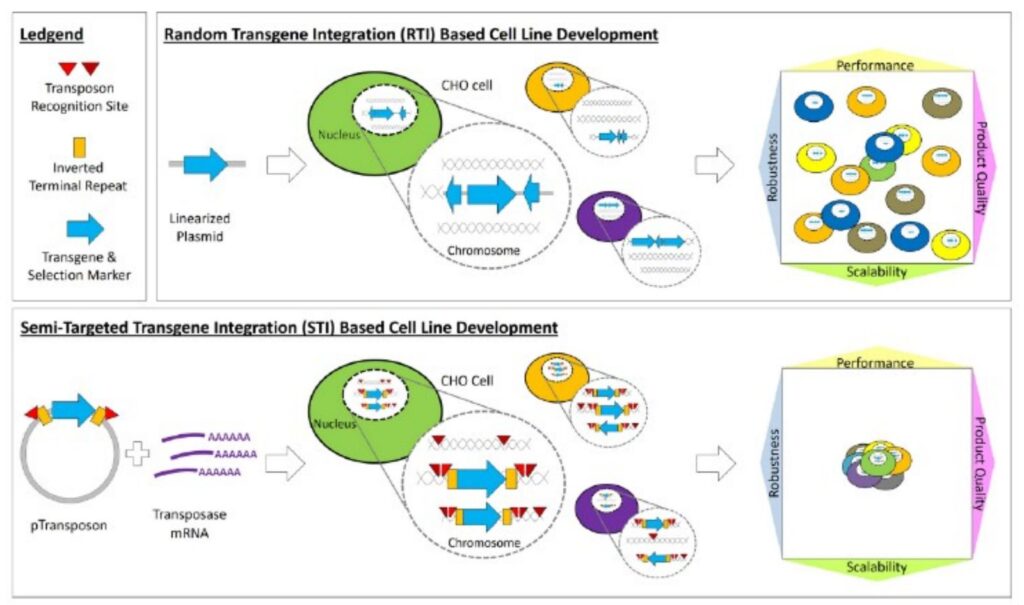
That distinction matters. The resulting pool remains polyclonal. It still requires appropriate characterization, including identity, purity, adventitious-agent testing and control of population doublings.
The objective is not to pretend that the pool is a clone. It is to create a predictable and characterizable manufacturing population.
What happens when the clone comes later?
Published experience provides evidence that stable-pool manufacturing does not necessarily foreclose a conventional cell line strategy later in development.
Work with transposon-generated pools has demonstrated GMP manufacturing at substantial scale followed by development of derivative clones. Comparisons of pool- and clone-derived processes have examined viable cell concentration, viability, antibody titer, cell-specific productivity and product-quality attributes including purity, charge variants and glycosylation.
The important conclusion is not that pool- and clone-derived material will always be identical. Rather, the relationship can potentially be characterized sufficiently to establish a molecule-specific comparability and bridging strategy.
This makes deferred cloning a sequencing strategy rather than a shortcut around cell line development.
Putting the concept to the test: Project Mariposa
At GBI Biomanufacturing, we designed Project Mariposa to test how this concept might work in a right-sized first-in-human manufacturing platform.
The study compared stable-pool and derivative-clone performance and evaluated production in a 7-liter OptimumGrowth® shake flask against a controlled 5-liter bioreactor. Core process variables, including seed train, feed strategy, glucose feeding and temperature-shift trigger, were held consistent to make the vessel comparison meaningful.
The results were encouraging.
| Cell population | 7 L OptimumGrowth flask | 5 L bioreactor | Difference |
|---|---|---|---|
| Stable pool | 3.99 g/L | 3.65 g/L | +9.5% |
| Derivative clone | 5.67 g/L | 4.73 g/L | +19.9% |
More importantly, increased titer did not correspond with an obvious deterioration in the product-quality measurements examined.
SDS-PAGE profiles were highly comparable between pool- and clone-derived samples and between flask and bioreactor conditions. Charge profiles measured by imaged capillary isoelectric focusing (iCIEF), size profiles measured by SEC-HPLC and glycan profiles were also comparable across the conditions evaluated.
These results should not be interpreted as demonstrating universal comparability between pools and clones. Every molecule presents its own expression, stability and product-quality risks. They do, however, demonstrate the type of evidence that can be generated when evaluating whether a stable pool is suitable for early clinical manufacturing.
Right-sizing downstream processing
Small-batch manufacturing also creates opportunities downstream.
Project Mariposa compared conventional packed-bed Protein A capture with membrane-based Protein A capture. Membrane capture achieved approximately 120 g/L/hour of capture productivity versus approximately 6 g/L/hour for packed-bed resin, while both approaches achieved capture recovery of about 93%.
For early clinical manufacturing, where batch size may be modest, this kind of process intensification can reduce processing burden without making product quality secondary. The same principle applies throughout the manufacturing train: the process should be sized for the clinical question being asked.
What this means for time and cost to the clinic
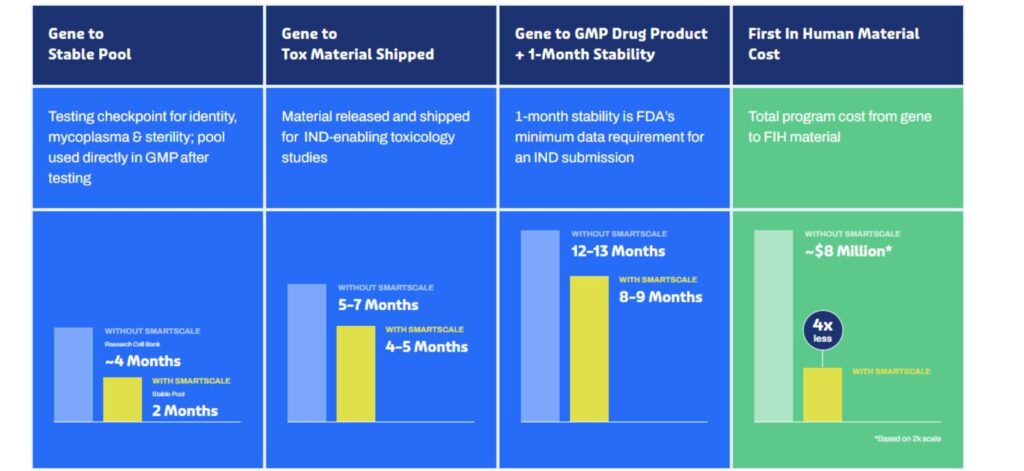
Moving single-cell cloning off the critical path compresses each milestone on the way to first-in-human material. Here is how program timelines compare with and without SmartScale™ GMP:
| Milestone | Without SmartScale | With SmartScale |
|---|---|---|
| Gene to stable pool (testing checkpoint for identity, mycoplasma and sterility) | ~4 months (research cell bank) | 2 months (stable pool) |
| Gene to tox material shipped (for IND-enabling toxicology studies) | 5–7 months | 4–5 months |
| Gene to GMP drug product + 1-month stability (FDA’s minimum data requirement for an IND) | 12–13 months | 8–9 months |
| Total program cost from gene to FIH material* | ~$8 million | ~4x less |
Rethinking the path to Phase 1
None of this argues for eliminating single-cell cloning. A successful biologic will ultimately require a development and control strategy appropriate for later clinical and commercial manufacturing.
The question is one of timing.
If a characterized stable pool can produce appropriate clinical material, single-cell cloning and establishment of a conventional production cell bank may not need to determine when every early-stage molecule reaches its first clinical study. Cloning can proceed in parallel, with comparability addressed as the program matures.
That changes the development question. Instead of automatically asking, “How quickly can we get to the final clone?”, drug developers can first ask:
“What evidence do we need to determine whether this molecule deserves to advance?”
For appropriately selected biologics, stable-pool manufacturing may provide a faster way to answer that question, and allow precious early-stage capital to follow the clinical evidence rather than precede it.
Explore SmartScale™ GMP

GBI developed SmartScale™ GMP as a gene-to-drug-product platform for right-sized early clinical manufacturing, combining Leap-In Transposase® stable pools, OptimumGrowth® 7 L production, in-house DS/DP manufacturing and phase-appropriate CMC. Learn how SmartScale can shorten your path to first-in-human.
Jesse McCool, PhD, is CEO of GBI Biomanufacturing.

Jesse D. McCool, Ph.D., is an operations executive, advisor, and board-level leader with 20+ years of experience scaling regulated manufacturing and mission-critical operations across biotech, CDMOs, and healthcare. He has held senior leadership roles at Lonza Group, Cytovance Biologics, Wheeler Bio, Bionova Scientific, and Our Blood Institute leading greenfield and brownfield facility start-ups and scale-ups and driving operational transformation. His background spans plasmid DNA manufacturing, monoclonal antibody development and production, and viral vector–enabled advanced therapy supply chains, with strengths in quality systems, tech transfer, and process validation. Jesse is known for disciplined operating rhythms, KPI-driven management, and culture-building that improves performance and customer experience. He earned his Ph.D. from the University of Massachusetts Amherst and completed postdoctoral studies at Dartmouth and TU Delft.